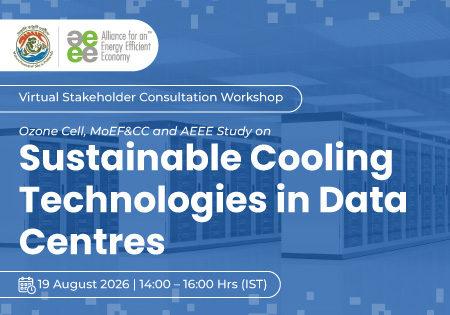
Date: 19 August 2026
Time: 14:00 – 16:00 Hrs (IST)
Background:
India’s data centre sector is expanding at an unprecedented pace, with cooling systems accounting for 30–50% of facility energy consumption. Additionally, reliance on high-GWP refrigerants makes refrigerant leakage a key source of direct emissions, reinforcing the sector’s importance under India’s Kigali Amendment commitments. The Ozone Cell, Ministry of Environment, Forest and Climate Change (MoEFCC), has commissioned AEEE to study sustainable cooling technologies in Indian data centres under HPMP Stage III.
The first stakeholder consultation, held in June 2026, highlighted the growth trajectory of India’s data centre sector, national and global developments, and perspectives from key stakeholders across the data centre ecosystem. Building on these discussions, the second stakeholder consultation presents the key findings of the study, showcases sustainable cooling technologies through solution-focused presentations, and brings together key government bodies such as Ozone Cell, BEE, and BIS to deliberate on the regulatory framework required for the sustainable growth of the data centre sector. Participants will gain insights from field assessments of data centres, emerging cooling technologies, and the evolving policy landscape. The workshop provides a unique platform for operators, policymakers, researchers, and technology providers to contribute to the national dialogue on sustainable data centre cooling.
Why Attend:
- Gain insights into the study’s key findings and recommendations on sustainable cooling pathways for India’s data centre sector
- Learn from real-world experiences and case studies shared by leading cooling technology providers
- Understand policy perspectives and emerging priorities shaping India’s sustainable data centre growth
- Contribute perspectives and recommendations that can help strengthen the study’s final outcomes
Who Can Attend:
- Government departments and policymakers
- Data centre owners and operators
- OEMs and technology providers
- Industry associations and energy auditors
- International agencies and civil society organisations
- Researchers and academic institutions

