By Meenatchi Sundaram, Lead Strategic Product Partnership, Pluss Advanced Technologies Ltd
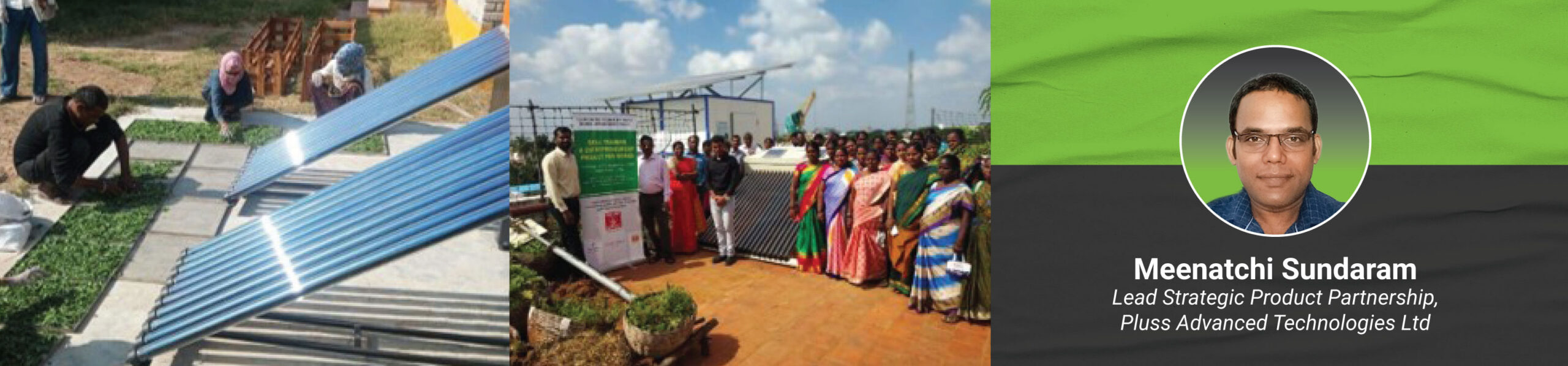
For many farmers, harvesting is only the beginning of the struggle. Fruits, vegetables, and flowers are highly perishable, and without proper storage, processing, and transportation, farmers must sell them quickly. This often forces distress sales, especially when markets are flooded with the same crop. Unreliable electricity and costly diesel‑based refrigeration make the problem worse, limiting farmers’ ability to reach distant, better‑paying markets. In this context, time becomes an economic resource – the ability to store, process, or transport produce longer directly impacts income.
Sustainable Solutions
To address these challenges, Advit Foundation introduced solar-powered drying in Rajasthan and cooling technologies in Tamil Nadu. The results show how technology can transform livelihoods and create new opportunities. Hemlata from Phagi used the Aagun® solar dryer to make sun-dried tomatoes, selling powdered tomatoes at Rs 600/kg – significantly higher than fresh tomato prices. Jitendra processed neem leaves into powder, creating a value-added product in demand for agriculture and health. Susheela, a 68-year-old entrepreneur, combined traditional papad and mongodi making with modern drying techniques, ensuring consistent quality and reducing dependence on weather. Meanwhile, women’s self-help groups in Chennai leveraged solar cold rooms to store flowers, enabling reliable supply to urban markets.
These stories point to a larger question – what happens when rural communities gain greater control over the time, quality, and form in which they sell their produce. The answer is not simply better storage. It means less wastage, longer shelf life, value addition, new products, and income opportunities.
What Makes This Possible?
These technologies are based on a simple scientific principle – thermal energy can be stored and released when needed. Phase Change Materials (PCMs) absorb and release large amounts of thermal energy as they change between solid and liquid states. This makes it possible to store cooling or heat and use it later, reducing the need for continuous electricity or diesel-powered operation.
Solar-PCM cold rooms such as Himacool® use daytime energy and PCM storage to maintain chilled or frozen conditions even without continuous solar power. PCM-based solar dryers such as Aagun® capture heat during the day and release it after sunset, ensuring continuous drying. Transport solutions such as ThermoTab™ and PronGO® maintain temperatures during farm-to-market logistics and last-mile delivery. Together, these applications support temperature continuity across different stages, from harvest to storage, processing, and transportation – reducing dependence on diesel and unreliable grid electricity.
Technology That Creates Choices
The experience of Advit Foundation suggests that the real value of these technologies lies in the choices they create. Farmers can store produce rather than sell immediately; households can process surplus crops instead of discarding them; entrepreneurs can add value rather than sell raw materials; and farmer organisations can aggregate, store, and access markets collectively. These choices contribute to higher and more stable incomes, reduced food losses, lower emissions, lower energy dependence, and new opportunities for local enterprises. Technology, therefore, is only one part of the story. The larger story is about empowerment and opportunity for communities.
Rethinking Pathways to Higher Farmer Incomes
 Improving farmer incomes is not only about increasing production – it is equally about what happens after harvest. Rural experiences show that post‑harvest management and value addition can transform livelihoods. Tomatoes dried into powder gain longer shelf life and fetch higher prices. Neem leaves processed into powder become marketable products for multiple uses. Papad and mongodi dried reliably turn traditional skills into small enterprises.
Cold storage gives farmers flexibility to sell at the right time, while temperature‑controlled transport expands access to distant, better‑paying markets. When powered by solar energy and supported by PCM thermal storage, these activities combine economic opportunity with environmental sustainability.
The Environmental Dividend
Sustainable cold-chain solutions powered by solar energy and PCMs deliver both economic and environmental benefits. By reducing reliance on diesel and conventional grid electricity, they lower greenhouse gas emissions while improving energy efficiency. Deployments of PronGO® cooling boxes and solar dryers have demonstrated carbon savings of approximately 950 tonnes of CO₂ annually in specific operational contexts by reducing diesel refrigeration. Off-grid operation supports communities with unreliable electricity, while PCM storage shifts demand away from peak periods, easing pressure on local grids. Every unit of produce preserved or processed represents avoided waste of land, water, energy, and labour.
The Road Ahead
The next opportunity is to develop decentralised, renewable-energy-based agricultural infrastructure that is economically viable and locally managed. This includes expanding solar-PCM cold rooms in hard-to-reach rural clusters, establishing community-level solar drying and processing centers, integrating PCM storage with electric and semi-electric farm-to-market transport, developing EV-based logistics for sustainable last-mile delivery, enabling FPOs and cooperatives to operate shared cold-chain infrastructure as viable businesses, and supporting rural women and entrepreneurs to develop value-added products. This approach goes beyond simply introducing technology into villages – it focuses on building local enterprises around sustainable infrastructure.
Sustainable cold-chain technologies, including solar-PCM dryers, cold rooms, and PCM-enabled transport, reduce post-harvest losses, extend shelf life, enable value addition, and connect rural producers to wider markets. Beyond individual users, these solutions can evolve into shared community infrastructure operated by FPOs, cooperatives, and rural enterprises. This creates pathways toward a decentralised, sustainable, and inclusive agricultural value chain, where farmers are active participants in storage, processing, logistics, and marketing. The overarching goal is to build an agricultural system in which producers have more time, more choices, and greater opportunity to capture the value generated from their produce.

